The sport itself
Kun Khmer: rules and rituals
How a Kun Khmer bout works: the rounds, the strikes that win fights, the pre-fight ritual and music, and where the sport comes from, from Angkor onward.
Reserve a ringside seat ↗Quick answer
Kun Khmer, also called pradal serey, is Cambodia's stand-up striking sport. Fighters use punches, kicks, knees and elbows, plus the clinch, over five rounds of three minutes in a square ring of about six metres. A bout opens with a ritual and live music, and it can end by knockout or on points. Elbows win more bouts than any other strike. The sport grew out of older Khmer martial arts and took its modern rules in the early twentieth century.
What Kun Khmer is
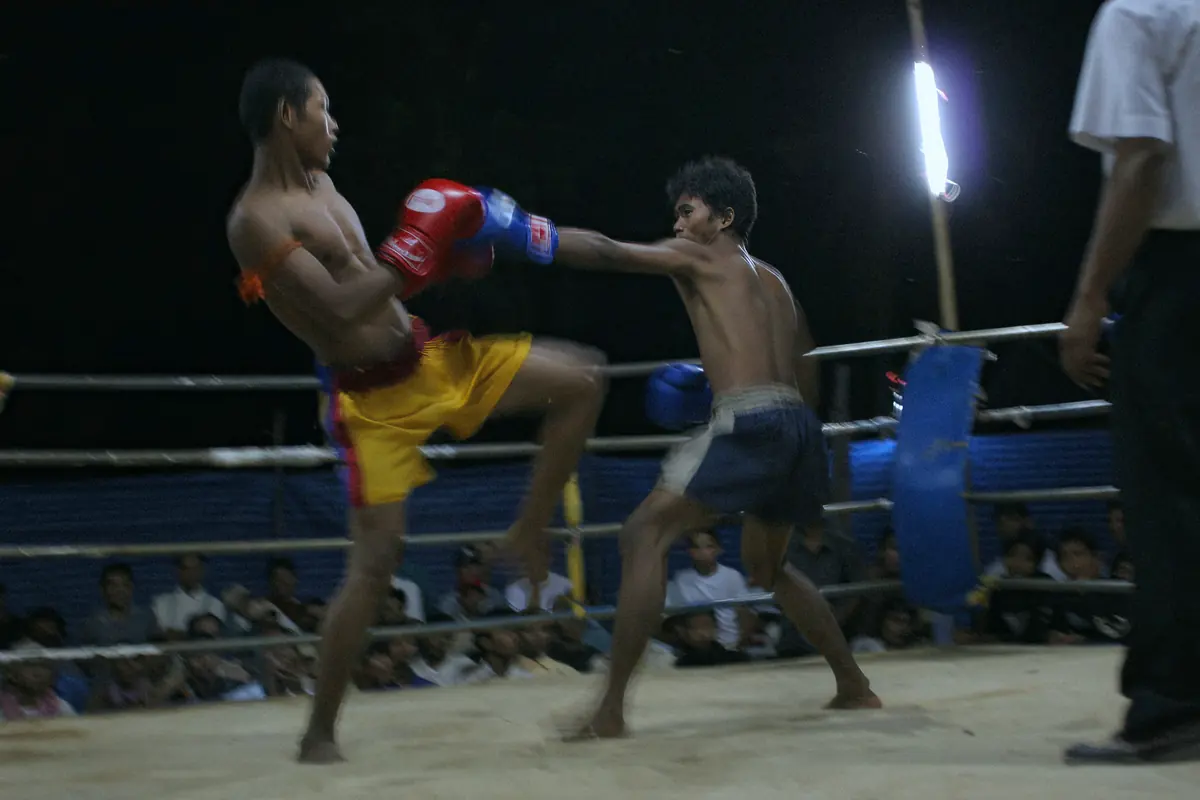
Kun Khmer is a combat sport built on stand-up striking and clinch fighting. Its other common name, pradal serey, is the one you will see in many English-language sources, and its full Khmer name is Kbach Kun Pradal Khmer. A bout can end by knockout, by a technical knockout or on points. Modern fighters wear leather gloves and nylon shorts, and the sport is popular enough in Cambodia that many weekly cards are shown on television. If you have seen kickboxing, the outline will look familiar. The detail, the ritual and the music are where Kun Khmer stands apart. It has also travelled: Wikipedia records the first school abroad opening in Long Beach, California, in 1987, and the sport now has international events and an international federation.
Rounds, ring and the count
A bout runs five rounds of three minutes in a square ring about six metres across, with one and a half or two minutes of rest between rounds. Friendship matches against fighters from other countries can be shortened to three rounds. If a fighter is knocked down and cannot beat the referee's ten-second count, the fight is over. The referee can also stop a bout early if a fighter clearly cannot get up unaided. Rounds that go the distance are scored by judges, so a fight with no knockout still has a clear winner or a draw. Five rounds of three minutes means fifteen minutes of fighting at most, though a knockout can end a bout far sooner, which is why one evening's bouts differ so much in length.
- Five rounds of three minutes, in a ring of about six metres
- A rest of about a minute and a half or two minutes between rounds
- A knockdown not beaten by the ten-count is a knockout
- The referee may stop a bout when a fighter cannot continue
How a bout is scored
Judges award points for effectiveness, not for the number of blows thrown. A fighter who keeps retreating loses points, and so does one who kicks an opponent who is down. If the scores finish level, the bout is a draw. The Cambodian Boxing Federation licenses the referees, judges and fighters, and television stations that stage cards do so under its supervision. For a visitor the rule of thumb is simple: the fighter who lands clean, hard strikes and controls the centre of the ring usually takes the round, even when the other has thrown more. The same federation supplies the timekeepers and the people who run each bout, so a card in Phnom Penh runs to a common set of rules from one evening to the next.
Strikes, and why elbows matter
Kun Khmer allows punches, kicks, knees and elbows, and it allows the clinch, where fighters hold each other at close range and strike. Kicks draw power from the hips, and the push kick can be aimed at the body or the face. Elbows are the signature: they produce more victories than any other strike, and sources describe Cambodian fighters as using them more than boxers in neighbouring styles. Some actions are banned, including striking a fallen opponent, biting, blows to the back, holding the ropes and blows to the groin. The clinch is where much of the close work happens, with fighters holding on at short range, striking with knees and elbows and trying to unbalance each other.
- Punches, kicks, knees and elbows are all allowed
- The clinch is part of the sport
- Banned: striking a fallen opponent, biting, blows to the back
- Banned: holding the ropes, blows to the groin
Before the first bell
Each bout opens with a ritual called kun kru, in which a fighter pays homage to his teachers and warms up. It is followed by music from a small live ensemble, led by an oboe-like instrument called the sralai, with drums marking the beat. The music has two parts: a slow opening for the ritual and a faster one for the fighting, which speeds up as a round goes on and stops at the end of the round or at a knockout. The ritual comes in many variations, several of them drawn from the Reamker, Cambodia's telling of the Ramayana epic. A separate guide to the ritual and the music explains what to listen for and why the tempo changes.
Read next: Kun kru and the fight music
Where the sport comes from
Kun Khmer grew out of older Khmer martial traditions, often grouped under the name Bokator, which is now listed by UNESCO. Bas-reliefs at Angkor-period temples, among them Angkor Wat, the Bayon, Ta Prohm, Banteay Samre and Preah Khan, show figures grappling and striking. An archaeologist with the authority that manages Angkor Archaeological Park has said some of these carvings are related to Kun Khmer, wrestling and Lbokator. The link between the stone and the modern sport is an interpretation, not a settled chain of evidence, so treat the carvings as context rather than proof. What the sources agree on is that Khmer fighting traditions are old, that soldiers used them, and that the sport you can watch tonight is a regulated modern form of them.
Read next: Lbokator: the older Khmer art
Gloves, rounds and the French rules
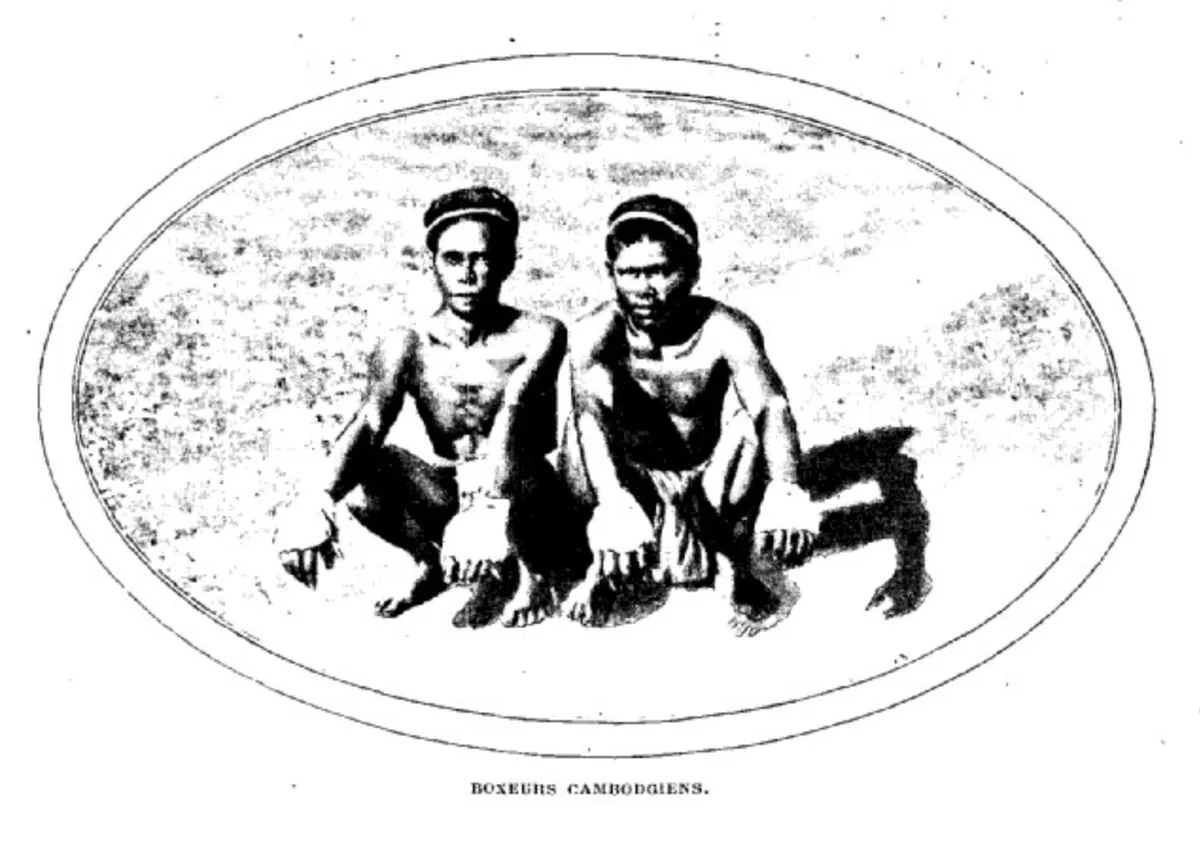
Early bouts were fought in dirt pits, with the hands wrapped in rope. The French colonial administration codified the sport in the early twentieth century, adding gloves, time limits and rest periods, and banning certain techniques. Rings, rounds and gloves turned a martial tradition into a regulated sport, and the same rules later spread to Vietnam and Laos. That is why a modern Kun Khmer card looks like a boxing card, with a gong, a referee and weight classes, even though the ritual and the music come from older Khmer practice.
Banned, then rebuilt
After the Khmer Rouge took power on 17 April 1975, traditional martial arts were banned. Many boxers were executed, worked to death or fled, and the sport nearly ended. After the regime fell in January 1979, survivors rebuilt it slowly, with gyms, a national federation and regular television cards. Today Phnom Penh stages bouts every week. That history is part of the sport's story today, and a visitor who knows a little of it will watch the evening differently. Treat the subject with the seriousness it deserves.
How it looks from ringside
At ringside the sport arrives through the senses before the rules. VICE described fighters bowing three times to the corners, a judge checking the gloves and a gong starting the match, with a small ensemble playing from a stage close to the audience. The music speeds up as the action does, and it stops when a round ends or a fighter goes down. Knowing the rounds, the scoring and the banned actions lets you follow a bout without a commentary, and it tells you why the room reacts when a fighter retreats or lands cleanly. If you can, watch the first few seconds of each round for the footwork, then the clinches for the knees and elbows.
A sport that travels
Kun Khmer is no longer only a Cambodian pastime. Wikipedia records a first school opening abroad, in Long Beach, California, in 1987, and an international federation that stages events and championships. A world championship has been held in Siem Reap, and events have taken place in South Korea and on Crete. For a visitor the point is practical: a card in Phnom Penh is the sport at home, in front of a local crowd, and Phnom Penh is one of the places where weekly cards are staged.
Who this isn't for
If you dislike watching fighters hit each other, skip live Kun Khmer: knockouts, clinches and elbows are the point. Anyone who wants a quiet seated show will be happier at a dance performance. And if you hope for a martial-arts lesson, a ringside seat shows you the sport but does not teach it. A class is a different booking. Fighters at a card are at work, so photos are for the moments the evening allows, such as the pictures with the boxers and the step into the ring afterwards. Parents should also weigh the minimum ages on the booking pages before bringing children to a night of full-contact fighting.
Frequently asked questions
What is the difference between Kun Khmer and pradal serey?
They are two names for the same Cambodian striking sport. Kun Khmer is the Khmer name used in Cambodia, and pradal serey is common in English sources. Its full Khmer name is Kbach Kun Pradal Khmer.
How long is a Kun Khmer bout?
Five rounds of three minutes, with a rest of about a minute and a half or two minutes between rounds. Friendship matches against fighters from other countries can be shortened to three rounds.
Are elbows allowed in Kun Khmer?
Yes. Punches, kicks, knees, elbows and the clinch are all allowed, and elbows produce more victories than any other strike. Striking a fallen opponent, biting and blows to the groin are banned.
How is a Kun Khmer fight scored?
Judges award points for effectiveness. Constant retreating and kicking a downed opponent cost points, and a tied score is a draw. A knockdown not beaten by the ten-count ends the fight.
Why does music play during the fights?
Live music is part of the sport. A slow opening accompanies the pre-fight ritual, and a faster section follows the rounds, speeding up as the action does and stopping at the end of a round or a knockout.
Is Kun Khmer the same as Bokator?
No. Kun Khmer grew out of older Khmer martial traditions often called Bokator, but Bokator is a separate system that also uses weapons and is practised alongside dance, music and traditional medicine.
Sources